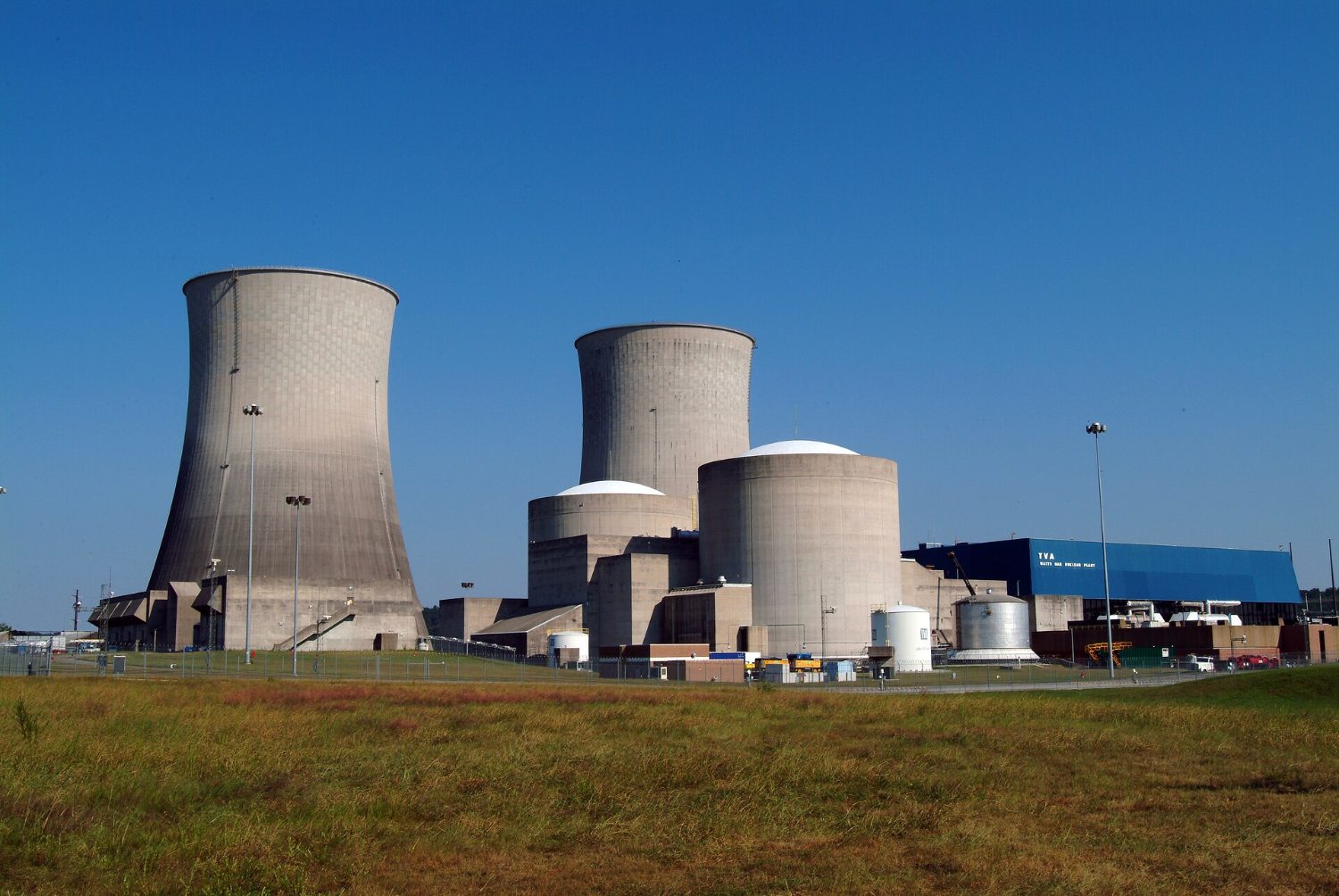
Watts Bar Nuclear Generating Station in Tennessee, shown as an example of a U.S. nuclear plant. Source: Tennessee Valley Authority via U.S. Nuclear Regulatory Commission and Wikimedia Commons. Public domain.
Quick Answer: Three Texas nuclear projects aimed squarely at AI data centers, Fermi America’s four AP1000 reactors near Amarillo, Blue Energy’s five BWRX-300 units at the Port of Victoria and Last Energy’s 30 microreactors in Haskell County, together propose about 6.5 gigawatts of new capacity; the state’s two existing nuclear plants together exceed 5,000 megawatts. None has a federal construction license yet, the earliest target dates are 2032 and 2033, and Texas has put $350 million of state money behind the sector.
Texas has spent three years positioning itself as the place where the next generation of American reactors gets built, and artificial intelligence is the customer most developers now name first. As of November 25, 2026, the state’s nuclear pipeline has real regulatory milestones behind it for the first time. This article sorts what is docketed from what is announced.
Why are AI developers looking at nuclear power in Texas?
The starting point is the size of the load. E&E News reported in May that ERCOT projects data centers could add more than 228 gigawatts of grid demand by 2032, against an all-time system peak of 85.5 gigawatts set in 2023.
Thomas Gleeson, chair of the Public Utility Commission of Texas, told an Austin conference on February 11 that the state may not have enough wind, solar and storage to serve 200 to 300 gigawatts of future load, and said: “If you believe in clean energy and care about the environment, nuclear has to be a part of that solution.”
Texas has two operating nuclear plants today, Comanche Peak southwest of Fort Worth and the South Texas Project near Matagorda Bay, which together exceed 5,000 megawatts.
What has the state done to encourage new reactors?
In August 2023, Gov. Greg Abbott directed the Public Utility Commission to form the Texas Advanced Nuclear Reactor Working Group. Its report recommended a coordinating office and a dedicated fund. House Bill 14, signed in June 2025, created both: the Texas Advanced Nuclear Energy Office, known as TANEO, and the Texas Advanced Nuclear Development Fund, to which the Legislature appropriated $350 million. Jarred Shaffer was named the office’s director in September 2025.
| Created by | House Bill 14, signed June 2025 |
| Appropriation | $350 million |
| Programs | Advanced Nuclear Construction Reimbursement Program; Project Development and Supply Chain Reimbursement Program |
| Applications opened | April 1, 2026 |
| Notice of intent / full application deadlines | April 23, 2026 / May 14, 2026 |
| Construction program threshold | NRC construction permit or license application docketed, or reasonably expected, on or before December 1, 2026 |
| Status | Application round listed as closed |
When applications opened, Shaffer said only two projects in the state met the docketed-application test for construction funding: the Dow and X-energy plant at Seadrift and Fermi America’s project near Amarillo. Last Energy’s Haskell County plan was in NRC preapplication and could reasonably expect to qualify. Abilene Christian University, which hosts Natura Resources’ molten salt research reactor, already received $120 million in separate state funding and is therefore limited to the design and supply chain program. TANEO’s fund page lists the application round as closed, and the office’s news page did not list any award recipients when reviewed for this article.
Which Texas nuclear projects are tied to AI data centers?
| Developer and site | Reactors | Nuclear capacity | NRC status | Target |
|---|---|---|---|---|
| Fermi America with Texas Tech, Carson County near Amarillo | Four AP1000 | About 4.4 GW | Combined license application docketed in part; draft environmental statement issued September 30, 2026 | First unit 2033 |
| Blue Energy, Port of Victoria | Five BWRX-300 | About 1.5 GW | First part of construction permit application submitted September 16, 2026 | 2032 |
| Last Energy, Haskell County | 30 pressurized water microreactors of 20 MW each | 600 MW | Preapplication | Not stated |
How far along is Fermi America’s Project Matador?
Fermi America’s Advanced Energy and Intelligence Campus, developed with Texas Tech University next to the Pantex plant, is the largest nuclear proposal in the state and the one most explicitly built around AI. The company’s original plan called for 11 gigawatts of on-site generation, including about 4.4 gigawatts from four AP1000 reactors, and later updates pointed closer to 17 gigawatts. Natural gas comes first: ENR reported that the Texas Commission on Environmental Quality approved a permit for 6 gigawatts of gas generation at the site and that Fermi planned to seek a further 5 gigawatts.
On the nuclear side, NRC records show Fermi submitted the first part of its combined license application on June 17, 2025 and a revised second part on August 20, 2025. The agency completed its acceptance review of those two parts on September 5, 2025.
The environmental track has moved quickly. Fermi joined an NRC pilot in which the applicant drafts the environmental impact statement under agency supervision. The draft was issued September 30, 2026, the 45-day public comment period ended November 23, and the NRC is targeting a final statement in December. The American Nuclear Society reported that NRC staff gave a preliminary recommendation in favor of the license, pending a successful safety review.
The safety review is where the open questions sit. The NRC’s schedule shows a revised safety analysis report targeted for June 30, 2027, the third part of the application, covering site characteristics, targeted for October 31, 2027, and completion of the acceptance review for all parts by December 15, 2027. Dates for the draft and final safety evaluations, the mandatory hearing and the commission’s decision are all listed as to be determined. ENR reported in April that Fermi was targeting a construction start in 2027 and commercial operation of the first unit in 2033.
Commercially, the campus signed its first binding customer lease in August with AI cloud provider TensorWave, for a data center supported by 222 megawatts of facility power, with the possibility of additional data centers and up to 650 megawatts. Lee McIntire was appointed chief executive the same month following a change in leadership.
What is Blue Energy proposing at the Port of Victoria?
Blue Energy’s plan pairs GE Vernova 7HA.02 gas turbines with five GE Vernova Hitachi BWRX-300 small modular reactors to power nearby data centers. The gas units provide power first and the reactors follow, with all five targeted to be online in 2032 for about 1.5 gigawatts of nuclear capacity. The company submitted the first part of its construction permit application on September 16, 2026, including a request for a limited work authorization that would allow some early site construction, and the NRC published notice in the Federal Register on October 8. The second half of the application is planned for the second half of 2027, after a full calendar year of required site data collection.
What about microreactors and the Texas A&M campus?
Last Energy announced on February 28, 2025 that it plans to site 30 microreactors on 200 acres in northwest Texas to power data centers. Each unit is a 20-megawatt pressurized water reactor, for 600 megawatts in total, and the project in Haskell County is in NRC preapplication.
In February 2025 the Texas A&M University System invited four developers, Aalo Atomics, Kairos Power, Natura Resources and Terrestrial Energy, to build on its RELLIS campus in Bryan. Terrestrial signed ground lease and research agreements in June 2026 giving it exclusive use of about 77 acres for its Integral Molten Salt Reactor, a 392-megawatt design. The company separately signed a memorandum of understanding with Riot Platforms in May 2026 to develop large-scale data center projects powered by multiple plants totaling up to 4 gigawatts.
Austin-based Aalo Atomics is the Texas company closest to operating hardware. Its test reactor reached criticality at Idaho National Laboratory on July 4, 2026, about eight months after groundbreaking. A second reactor under construction at the Idaho site is intended to produce electricity and power an on-site data center in 2027. The company’s commercial product is a 50-megawatt pod of multiple reactors marketed for AI data centers.
What did the Long Mott construction permit prove?
The clearest sign that the federal process can move came on November 9, 2026, when the NRC issued a construction permit for the Long Mott Generating Station at Dow’s Seadrift site on the Texas coast. The plant would use four X-energy Xe-100 high-temperature gas-cooled reactors of 80 megawatts each, 320 megawatts in total, to supply power and steam to a chemical complex. It is not a data center project. Its relevance to AI developers is the precedent: the NRC reached its decision within 18 months of starting the review.
The permit also shows how much remains after licensing. Dow and X-energy say no final decision to build has been made, a preliminary investment decision is expected in 2027, and commercial operation would come in the early 2030s. That is for a project with roughly $2.15 billion in cost-shared U.S. Department of Energy funding.
What are the main obstacles?
Can new nuclear compete on cost in ERCOT?
Cost is the central issue. The Texas Tribune reported that a UT grid model found nuclear would be built in ERCOT only if upfront capital costs fall to $3 million per megawatt or less, while National Renewable Energy Laboratory projections put small modular reactor costs at $2.9 million to $10.1 million per megawatt. Without major cost reductions, the researchers concluded, nuclear may not be cost-competitive in Texas before 2040. No small modular reactor has reached commercial operation in the United States, and NuScale Power, the first company to receive federal approval for such a design, canceled its Idaho project in 2023 after costs rose.
That is why the data center link matters to developers: a reactor selling directly to a campus under a long-term contract does not have to clear the ERCOT wholesale market on price alone. It is also why most AI-related proposals in Texas, including Fermi’s and Blue Energy’s, begin with natural gas and add nuclear later.
How long will it take?
Even at its fastest, NRC review takes at least 18 months, and newer designs need operating data from demonstration reactors before commercial licensing. The earliest target dates among the Texas AI-linked projects are 2032 for Blue Energy and 2033 for Fermi’s first unit. ERCOT, by contrast, expects new data centers to come online between 2028 and 2032. On current schedules, the first wave of Texas AI campuses will run on gas and grid power, and nuclear would serve later phases.
Brian’s Take
As a former investment manager and analyst, the habit I keep is separating what has been filed from what has been announced. On that test the Texas nuclear story is more real than it was a year ago, and still early. Fermi has a docketed application and a draft environmental statement, but every safety review date on the NRC’s schedule reads “to be determined.” Blue Energy has filed half an application. Last Energy is in preapplication. Those are meaningful steps. They are not reactors.
The number I keep coming back to is the gap between the dates. ERCOT expects data centers to arrive between 2028 and 2032; the earliest nuclear targets here are 2032 and 2033. So the honest description of these campuses, for now, is gas projects with a nuclear option attached. It may be the only practical way to finance a first reactor, with a paying AI tenant in place before the nuclear capital is committed.
The $350 million state fund is helpful, but look at the scale: Long Mott alone has about $2.15 billion in federal cost share and still has no final investment decision. For Texas business owners, I would treat nuclear as a serious part of the 2030s power picture and plan the next five years around the grid and gas supply that actually exist.
Frequently Asked Questions
Is any nuclear reactor powering a Texas AI data center today?
No. Texas has two operating nuclear plants that feed the grid, but none of the proposed data center reactors has a federal construction license. The earliest stated targets are 2032 and 2033.
How much nuclear capacity is proposed for Texas data centers?
Fermi America’s four AP1000 units (about 4.4 gigawatts), Blue Energy’s five BWRX-300 units (about 1.5 gigawatts) and Last Energy’s 30 microreactors (600 megawatts) total about 6.5 gigawatts.
What is the Texas Advanced Nuclear Development Fund?
It is a $350 million state fund created by House Bill 14 in 2025 and run by the Texas Advanced Nuclear Energy Office. It reimburses construction costs and project development and supply chain costs. Applications were due May 14, 2026.
Has the NRC approved any new reactor construction in Texas?
Yes. On November 9, 2026 it issued a construction permit for the 320-megawatt Long Mott Generating Station at Dow’s Seadrift site, an industrial project using four X-energy reactors.
Sources and Further Reading
- Texas opens $350M in nuclear funding, Nuclear Newswire, American Nuclear Society
- Texas Advanced Nuclear Development Fund program page and Governor Abbott, TANEO Boost Advanced Nuclear Construction (press release), Office of the Texas Governor
- Fermi America Project Matador AP1000 Units 1-4 combined license application review page, U.S. Nuclear Regulatory Commission
- Fermi America, Blue Energy make strides in Texas, Nuclear Newswire, American Nuclear Society
- NRC issues construction permit for Dow/X-energy Long Mott project, Nuclear Newswire, American Nuclear Society
- With a $350M Nuclear Fund Approved, Texas Wants Projects to Fill It, Engineering News-Record
- Momentum is building to meet electricity demand in Texas with small nuclear reactors, The Texas Tribune via Texas Public Radio
- Aalo Atomics achieves criticality on July 4; Terrestrial Energy and Texas A&M reach agreement on reactor siting; Texas-sized nuclear plans grow with news from Natura and Last Energy, Nuclear Newswire, American Nuclear Society
- Texas water plan ignores data center surge (ERCOT load projections), E&E News by POLITICO