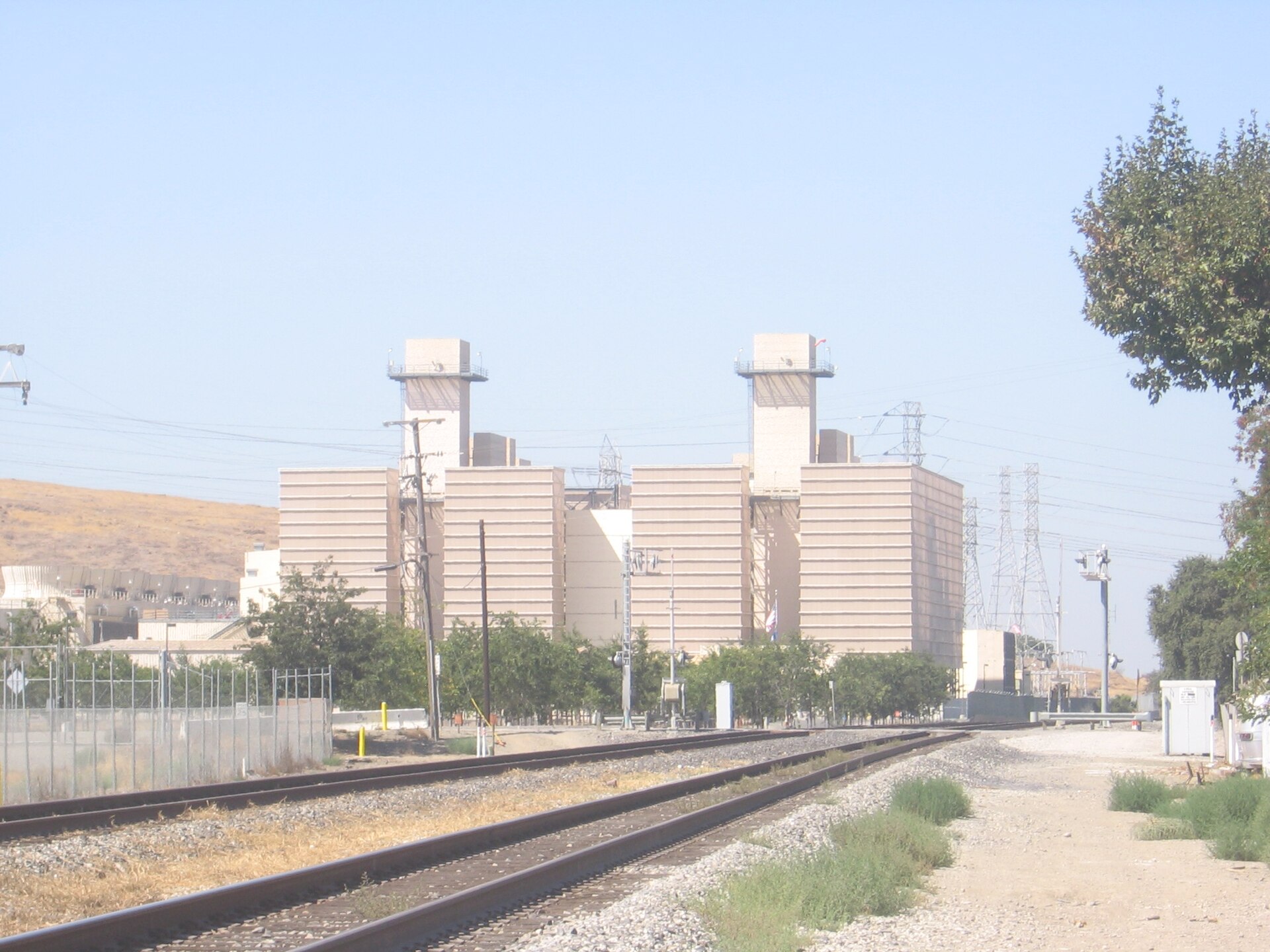
Photo: Pedro Xing, via Wikimedia Commons. CC0 1.0 public domain dedication. Shown: Metcalf Energy Center, a gas-fired plant in California.
The usual question about AI data centers in Texas is whether the grid can serve them. A growing number of developers are answering a different question: what if the data center brings its own power plant? Across the state, companies are permitting natural gas plants built to feed a single campus. This article sets out what has been proposed, what has been permitted and what is still on paper, as of November 21, 2026.
How many gas plants are planned for Texas data centers?
Two independent trackers have counted them, using different methods, and both put Texas first.
The Environmental Integrity Project reviewed Clean Air Act construction permit applications, draft permits and final permits for projects in planning, permitting or construction through April 2026. As reported by the Texas Tribune on July 1, 2026, it found at least 74 natural gas plants of 100 megawatts or more planned to supply data centers directly across the country, 71 of them new and three of them expansions, totaling about 143 gigawatts. Thirty-two of the 74 are in Texas, about 43% of the national count and more than any other state. Most of the Texas plants are proposed for West Texas.
Global Energy Monitor, which tracks gas plants worldwide, reported in January 2026 that the Texas pipeline of gas power projects grew by nearly 58 gigawatts during 2025, more than California’s peak power demand. About 40 gigawatts, nearly half of the state’s upcoming gas projects, is planned to power data centers directly. Only China has more gas power in development than Texas.
| Measure | Figure | Source |
|---|---|---|
| Gas plants of 100 MW or more planned to serve data centers directly, U.S. | 74 (about 143 GW) | Environmental Integrity Project |
| Of those, located in Texas | 32 | Environmental Integrity Project |
| Growth in Texas gas power pipeline during 2025 | Nearly 58 GW | Global Energy Monitor |
| Texas gas capacity planned to power data centers directly | About 40 GW | Global Energy Monitor |
| Texas gas projects under construction / preconstruction / announced | 11 / 102 / 28 | Global Energy Monitor |
| Data center projects planned statewide | At least 248 | Texas Tribune count |
| Large-load requests submitted to ERCOT as of May 2026 | About 439 GW, roughly 89% data centers | Texas Tribune, citing ERCOT |
Global Energy Monitor counted 11 Texas gas projects under construction, 102 in preconstruction and 28 announced. If every one were built, the state’s gas generation capacity would more than double. That is a ceiling, not a forecast.
Why are data centers building their own power plants?
Is the grid queue the reason?
It is a large part of it. As of May 2026, developers had submitted requests to connect about 439 gigawatts of future demand to the ERCOT grid, the Texas Tribune reported. Roughly 89% of those requests came from data centers, and the total is about five times the state’s record peak demand. A developer that generates on site, often called behind-the-meter power, does not have to wait for transmission lines and substations to be studied and built before the first servers turn on.
How fast can an on-site plant be permitted?
For smaller plants, quickly. An Environmental Integrity Project analyst told the Texas Tribune and Inside Climate News that many data center gas projects of up to 500 megawatts, enough for more than 200,000 homes, received permits from the Texas Commission on Environmental Quality within about a month. One example is Misae Gas Power outside San Antonio, which applied on December 23, 2025 to install 206 gas generators totaling 519 megawatts for a data center and received its permit on January 14, 2026.
Does policy favor on-site power?
Increasingly. In March 2026, President Donald Trump encouraged data center developers to build dedicated power plants as part of his Ratepayer Protection Pledge. In June 2026, Governor Greg Abbott directed state utilities to make sure developers, not existing customers, pay the infrastructure costs of new data centers. The Texas Tribune reported that Abbott plans to make regulation of the AI industry a priority in the 2027 legislative session and to propose requiring new facilities to add generation to the grid.
Which Texas projects are the largest?
Five projects named in the reports reviewed here add up to about 18 gigawatts of gas capacity on their own, counting Project Matador at the 6 gigawatts in its air permit applications.
| Project | Developer | Location | Gas capacity | Status |
|---|---|---|---|---|
| GW Ranch | Pacifico Energy | Pecos County | 7.65 GW | State air permit issued January 2026 |
| Project Matador | Fermi America | Near Amarillo | 6 GW in air permit applications; campus could need up to 11,200 MW | 2.2 GW of current capacity per the company; first 600 MW development to begin in 2027 |
| Project Kilby | Chevron subsidiary Energy Forge One, with Engine No. 1 | West Texas | 2.67 GW | Final investment decision targeted by end of 2026; first power 2028 |
| Sandow Lakes Power Plant | Not named in reports | Lee County | 1.2 GW | Permit issued October 2025; construction begun |
| Misae Gas Power | Misae Gas Power | Outside San Antonio | 519 MW from 206 generators | Permit granted January 14, 2026 |
What is GW Ranch?
GW Ranch is a 7.65 gigawatt complex of gas plants and data centers planned by Pacifico Energy in Pecos County, near the oilfields of the Permian Basin. Pacifico calls it the largest power project in the United States. In late January 2026 the Texas Commission on Environmental Quality issued its air permit, described by Inside Climate News as the largest air pollution permit in the country. The permit authorizes up to 33 million tons per year of greenhouse gases.
What is Fermi America building near Amarillo?
Fermi America applied in August 2025 for air permits covering 6 gigawatts of gas power at Project Matador, its campus outside Amarillo. The Texas Tribune reported that the full campus could need up to 11,200 megawatts, enough for 2.75 million homes. In its third-quarter results released November 12, 2026, the company said it has nearly $1.7 billion invested in the buildout and 2.2 gigawatts of current capacity. It also announced agreements with an unnamed investment-grade hyperscaler for an initial 600 megawatts, with development beginning in 2027 and more than $200 million committed up front. The parties are still working toward a definitive long-term lease, and a separate lease signed with TensorWave in August 2026 has been terminated, so the campus does not yet have a final tenant lease.
What are Chevron and Microsoft building?
Chevron’s project is the clearest example of an oil and gas producer moving into power for AI. Oil and Gas Journal reported on June 23, 2026 that Energy Forge One, a wholly owned Chevron subsidiary, will build Project Kilby, a 2.67 gigawatt gas plant located alongside a data center that Microsoft will operate in West Texas. Microsoft will take the electricity under a 20-year power purchase agreement. Investment firm Engine No. 1 collaborated on development.
Large GE Vernova turbines will supply most of the generation, with additional capacity from Solar Turbines, a Caterpillar subsidiary. Chevron expects a final investment decision by the end of 2026 and first power in 2028. The plant is designed to use non-potable, brackish groundwater instead of freshwater and to control nitrogen oxide emissions with selective catalytic reduction. Chevron had said in November 2025 that its first power plant could eventually produce up to 5 gigawatts for AI.
What about Central Texas?
The Sandow Lakes Power Plant, a 1.2 gigawatt project in Lee County about 50 miles east of Austin, received its state permit in October 2025, and construction has begun.
What has been permitted since September?
Permit activity continued through the fall. A summary of Texas Commission on Environmental Quality actions compiled by the advocacy group Public Citizen lists three major-source air permit notices mailed on September 22, 2026:
- VoltaGrid, for the Vantage Frontier data center campus in the Abilene area;
- NRG, for the NRG Prairie Energy Center at Grandview in Hill County;
- Nexus, for the Nexus data center at Hubbard, also in Hill County, with a public comment period that ran from September 24 to October 23.
The same summary lists four smaller air authorizations under review: BT Gateway’s data center at Royse City in Hunt County, the Kilby Power Plant for Chevron and Microsoft, and two Edged Energy sites, one in Irving and the Caldwell Power Generation Plant at Martindale in Caldwell County. The list is one advocacy group’s compilation of agency records, not an official tally.
How much natural gas would these plants burn?
Enough to matter to Permian producers. A researcher at Rice University’s Baker Institute calculated for the Texas Tribune and Inside Climate News that GW Ranch alone, running at full capacity, could use 1 billion to 2 billion cubic feet of gas per day. That equals 4% to 7% of the gas produced in the Permian Basin in 2025.
For Texas business, this is the commercial logic behind the West Texas projects. A power plant beside a data center turns gas into electricity near where it is produced. Chevron’s entry, with a 20-year contract from Microsoft, shows a producer capturing that value directly. A Chevron executive said at a June 2026 energy conference that the company views Kilby as a platform for growth and is exploring more partnerships with Microsoft and other companies.
What are the emissions and local concerns?
The permit records also quantify the environmental side. The Environmental Integrity Project estimated that the 32 Texas plants could emit more than 287 million tons of greenhouse gases a year, which it equates to about 61 million gasoline-powered cars driven for a year. At maximum capacity the plants could also emit more than 14,000 tons of fine particulate matter, 20,000 tons of nitrogen oxides and 8,000 tons of volatile organic compounds.
The Texas Tribune noted that most of the proposed plants are in West Texas, where air quality monitoring is limited, and that a few are in or near areas that already fail federal ozone standards, including a proposed plant in San Antonio. The city of San Marcos passed a ban on data centers. The Data Center Coalition, an industry group, told the Tribune that its members have led on energy efficiency and are committed to environmental stewardship while protecting ratepayers.
Will all of these plants actually be built?
Almost certainly not, and the sources say so plainly. The Texas Tribune reported that projects of this kind typically come online about 100 megawatts at a time over several years and may never reach their full permitted capacity. The Baker Institute researcher cautioned that some announced projects may not be built and that some developers overstate what they can deliver.
The projects also sit at very different stages. Sandow Lakes is under construction. GW Ranch and Misae hold permits. Chevron has a signed 20-year customer but has not yet made its final investment decision. Project Matador has money in the ground and customer agreements but no final lease. A permit is permission to build, not a commitment to build.
Frequently Asked Questions
How many gas power plants are planned for data centers in Texas?
The Environmental Integrity Project counted 32 gas plants of at least 100 megawatts planned to serve Texas data centers directly, out of 74 nationwide, based on permit records through April 2026.
What is the largest data center power project in Texas?
By permitted gas capacity, GW Ranch in Pecos County at 7.65 gigawatts. Fermi America’s Project Matador near Amarillo could need up to 11,200 megawatts if fully built.
When will the Chevron and Microsoft plant start operating?
Chevron targets a final investment decision by the end of 2026 and first power delivery in 2028 for the 2.67 gigawatt Project Kilby in West Texas, under a 20-year power purchase agreement with Microsoft.
How much gas could one of these campuses use?
A Rice University Baker Institute researcher estimated that GW Ranch at full capacity could burn 1 billion to 2 billion cubic feet per day, or 4% to 7% of 2025 Permian Basin gas production.
Sources and Further Reading
- Texas leads nation in proposed power plants for data centers, which would emit large amounts of greenhouse gases – The Texas Tribune
- In the West Texas oil patch, companies plan gas power plants to run new data centers – The Texas Tribune and Inside Climate News
- Developer Calls GW Ranch in Pecos County, Texas, the Largest Power Project in U.S. – Inside Climate News
- Chevron to build gas-fired West Texas power plant, supply Microsoft – Oil and Gas Journal
- Fermi Announces New Agreements with Investment-Grade Hyperscaler and Third Quarter 2026 Financial Results – Fermi Inc.
- Summary: Data Center Permits Issued by TCEQ After September 21, 2026 – Public Citizen