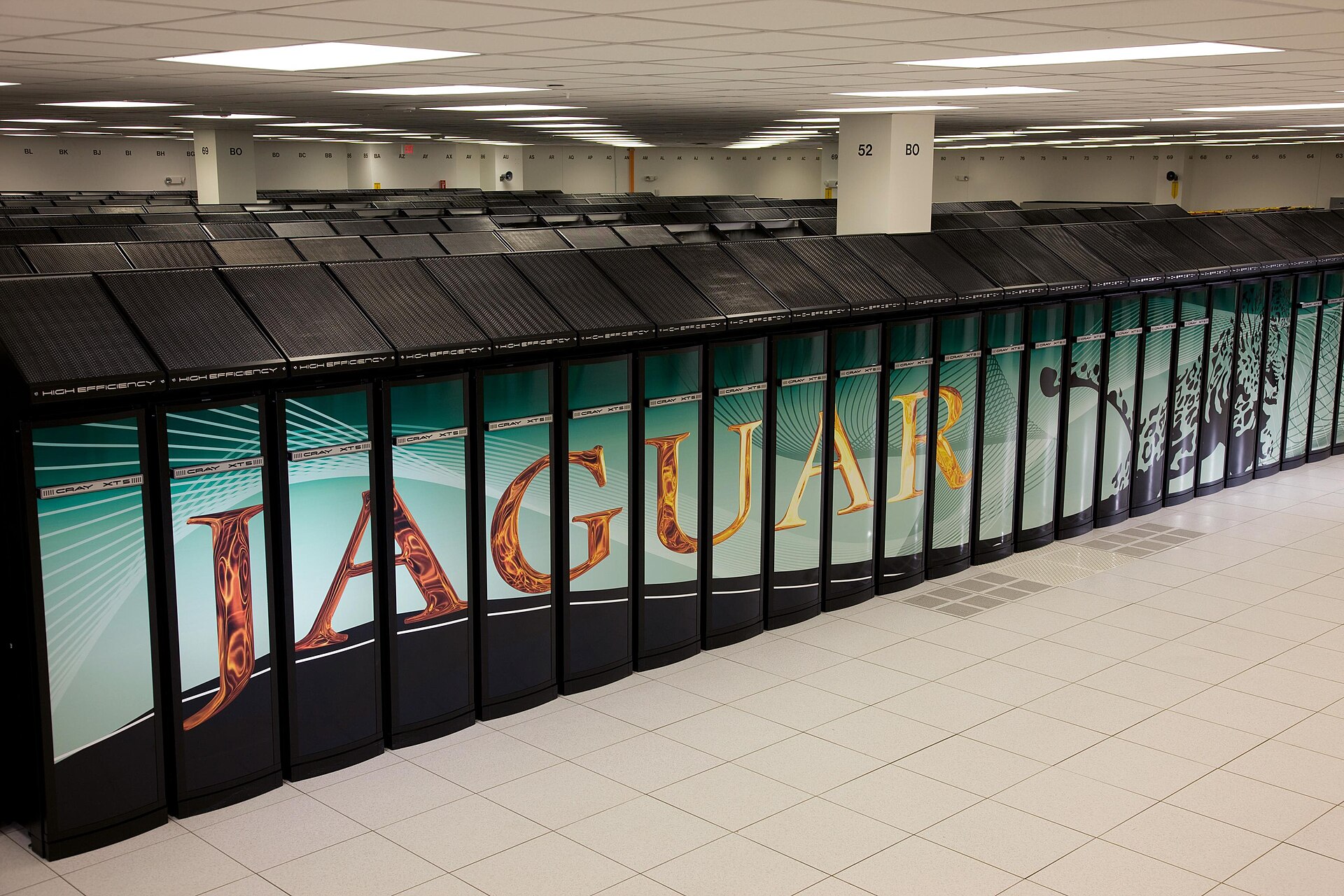
Photo: U.S. Department of Energy via Wikimedia Commons. License: Public domain.
Quick Answer: The University of Texas at Austin opened its Horizon supercomputer to early users on November 17, 2026, with 4,000 NVIDIA Blackwell GPUs running and a CPU expansion due in early 2027. Horizon entered the November 2026 TOP500 list at No. 24 with 132 petaflops, the highest-ranked academic system in the United States, ahead of Texas A&M’s VISION at No. 72. The National Science Foundation committed an initial $457 million to build the facility that houses it.
Texas universities now operate the two highest-ranked academic supercomputers in the United States, and both were built with artificial intelligence workloads in mind. The Texas Advanced Computing Center (TACC) at UT Austin announced on November 17, 2026 that Horizon, the flagship of the National Science Foundation’s Leadership-Class Computing Facility, has opened to its first researchers. Texas A&M’s VISION system, a $45 million purchase, has been on the TOP500 list since June 2026.
What is Horizon and what is its status in November 2026?
Horizon is the main computer of the NSF Leadership-Class Computing Facility, a designation the National Science Foundation awarded to TACC on July 11, 2024. It is installed in a Sabey Data Centers facility in Round Rock, not on the UT campus. UT’s November 17, 2026 release describes the site as a new 20 megawatt data center with liquid cooling.
The system is arriving in two phases. Phase one is the GPU partition, which is the part now open to early users. Phase two is a large CPU partition built on NVIDIA Vera processors. UT’s release says the CPUs will be added in early 2027. TACC’s allocations page had previously given the window as the end of 2026 or possibly early 2027, depending on processor delivery.
The schedule has moved more than once. NSF and UT said in July 2024 that the facility would begin operations during 2026. A TACC release from November 2025 pointed to production in spring 2026. TACC took early operations proposals from April 15 to June 15, 2026 and told users to expect GPU access that summer. The formal opening to early users came on November 17.
| Horizon key fact | Figure | Source and date |
|---|---|---|
| NSF initial construction investment | $457 million | UT Austin, July 2024 |
| GPUs in phase one | 4,000 NVIDIA Blackwell | UT Austin, November 2026 |
| GPU nodes | 2,000 Grace Blackwell nodes | TACC allocations page |
| CPU nodes in phase two | 4,750 Vera nodes, early 2027 | TACC allocations page; UT Austin |
| Measured performance | 132 petaflops, No. 24 | TOP500, November 2026 |
| Local storage | 400 petabytes, all solid state | UT Austin, November 2026 |
| Data center | 20 megawatts, Round Rock | UT Austin, November 2026 |
How much is the federal government paying for Horizon?
UT Austin’s July 2024 announcement said the NSF designation came with an initial investment of $457 million for construction of the Leadership-Class Computing Facility. That figure covers the facility, not only the computer. NSF’s own release says the facility also provides large-scale data storage and interactive computing, and it names four partner science centers in Georgia, Illinois, Pennsylvania and California.
The money arrives in annual installments. The Daily Texan, UT’s student newspaper, reported on February 12, 2026 that NSF would provide $72 million for Horizon in fiscal year 2026 and that the project had already received $247 million of a planned total approaching half a billion dollars.
For scale, TACC lists Frontera, the predecessor, as funded by a $60 million NSF grant awarded in 2018. The figures are not like for like, since the Horizon total includes a leased data center, a storage archive and partner programs.
Did Texas put state money into university AI computing?
Yes, in at least two verified cases. UT Austin said in November 2025 that the Texas Legislature had appropriated $20 million toward a portion of the additional GPUs it was acquiring. Separately, the Texas A&M Engineering Experiment Station said in July 2026 that its new IGNITE computing platform is funded by the State of Texas, without stating an amount.
What hardware is inside Horizon?
The GPU partition consists of 2,000 Dell and NVIDIA Grace Blackwell nodes, according to TACC’s allocations page. Each node pairs one 72-core NVIDIA Grace CPU with two Blackwell GPUs, which produces the 4,000 GPU total. The TOP500 entry for Horizon lists 144,000 cores, which matches 2,000 nodes at 72 cores each and indicates that the November 2026 ranking reflects the GPU partition alone.
The CPU partition will add 4,750 nodes, each with two 88-core Vera CPUs. That works out to 836,000 Vera cores. Combined with the Grace cores already installed, the total is about 980,000, in line with TACC’s description of a system with 1 million CPU cores.
Other verified components include NVIDIA InfiniBand networking and 400 petabytes of all solid state local storage, which UT says delivers more than 12 terabytes per second of read bandwidth. Dell Technologies supplied the servers. A companion archive called Ranch, with more than one exabyte of capacity, was deployed in September 2025 as the facility’s first production system.
How does TACC charge researchers for time?
Horizon time is free to researchers but rationed through peer review. During early operations, TACC offered awards of 125,000 to 500,000 service units over six months. One service unit equals one hour on a GPU node. TACC states that 500,000 service units is nearly 5% of the system’s full annual capacity. TACC expects 10,000 to 15,000 users a year once the system is in full production.
How much faster is Horizon than Frontera?
There are two answers, and each measures something different.
The design target, repeated by NSF and UT since 2024, is 10 times Frontera’s performance for simulation and more than 100 times for AI applications. A TACC article from July 2026 gave a wider range for real science codes, saying applications were expected to run 15 to 20 times faster.
The measured figure is smaller, for now. On the November 2026 TOP500 list, which ranks machines by the High Performance Linpack benchmark, Horizon posted 132 petaflops. Frontera, still listed at No. 96, is recorded at 23.52 petaflops. That is a ratio of about 5.6 to 1. The gap between 5.6 and 10 is explained largely by the missing CPU partition. UT’s release says performance will climb further when the CPUs are installed.
Why do the published performance figures differ?
TACC’s headline capacity figures have changed over time, and readers should treat them with care. A November 2025 TACC release described Horizon as a 300 petaflop system. UT’s November 2026 release lists 140 peak petaflops from the GPUs and 180 petaflops projected for the combined GPU and CPU system. Peak figures are theoretical maximums; the 132 petaflop TOP500 result is the only independently benchmarked number. For AI work, UT cites 20 exaflops at 16-bit precision and 80 exaflops at 4-bit precision, lower-precision arithmetic that does not compare directly with the simulation figures.
What happened to Frontera?
TACC retired Frontera in October 2026. The system was deployed in June 2019 with 8,368 compute nodes of 56 cores each and completed more than 8 million jobs over more than seven years. TACC had told users its queues would stay open on a best effort basis until September 30, 2026.
How do the Texas university systems compare?
| System | Operator | AI hardware | Status, November 2026 | Funding |
|---|---|---|---|---|
| Horizon | TACC, UT Austin | 4,000 NVIDIA Blackwell GPUs | Early users; TOP500 No. 24, 132 petaflops | NSF, $457 million initial for facility |
| VISION | Texas A&M University System | 760 NVIDIA H200 GPUs in 95 DGX nodes | TOP500 No. 72, 34.82 petaflops | $45 million, A&M System |
| Vista | TACC, UT Austin | 600 NVIDIA Grace Hopper nodes | Full production since September 2024 | NSF supplement to Frontera award |
| Center for Generative AI cluster | UT Austin, hosted by TACC | More than 1,000 GPUs after doubling | Expansion announced November 2025 | Includes $20 million state appropriation |
| IGNITE | Texas A&M Engineering Experiment Station | AMD Instinct MI355X GPUs, count not stated | Contract announced July 2026; no opening date given | State of Texas, amount not stated |
| Frontera | TACC, UT Austin | Mainly CPU; 8,368 nodes | Retired October 2026; 23.52 petaflops | NSF, $60 million |
What is UT Austin’s Center for Generative AI cluster?
UT Austin launched the Center for Generative AI in January 2024 with a plan for a cluster of 600 NVIDIA H100 GPUs, hosted and supported by TACC. Its stated focus areas are biosciences, health care, computer vision and natural language processing.
On November 10, 2025, UT said it was doubling the center’s capacity to more than 1,000 advanced GPUs, with the Legislature’s $20 million covering part of the cost. Unlike Horizon, which is a national resource allocated by peer review, the center’s hardware is dedicated to UT faculty and student researchers whose projects need hundreds of GPUs running in parallel.
Vista sits alongside it. TACC put Vista into full production in September 2024 as an NSF-funded bridge to Horizon. TACC’s user guide lists 600 Grace Hopper GPU nodes and 256 CPU-only nodes of 144 cores each. UT describes Vista as the proving ground for Horizon. With Horizon installed, UT says TACC now holds nearly 5,500 GPUs in total.
What has Texas A&M invested in AI supercomputing?
The Texas A&M University System announced in February 2025 that it would buy an NVIDIA DGX SuperPOD for $45 million, with additional spending on data center upgrades and installation. The purchase was made through World Wide Technology, an NVIDIA channel partner, and the system said it would triple the university’s supercomputing capacity.
The machine, named VISION, contains 95 NVIDIA DGX nodes with 760 H200 GPUs and sits in the West Campus Data Center in the Bryan-College Station area. It recorded 34.82 petaflops on the Linpack benchmark. On the June 2026 TOP500 list it ranked No. 66 and was the highest-ranked university system in the United States. On the November 2026 list it stands at No. 72, with the same benchmark result, and Horizon has overtaken it.
VISION serves researchers across the A&M System’s 12 universities and eight state agencies. Its June 2026 release cited one drug discovery project that screened more than 10 million compounds in about a week.
A second A&M project followed. On July 24, 2026, the Texas A&M Engineering Experiment Station said it had selected Dell Technologies to build IGNITE, an AI and high-performance computing platform using AMD Instinct MI355X GPUs in an Equinix data center in Dallas. The release did not give a GPU count, a cost or an opening date.
Which other Texas universities have announced AI computing?
Two smaller announcements are verified. The University of Texas at Arlington unveiled a $2.1 million on-campus supercomputing hub in July 2025; before that, its researchers relied on TACC. Texas Tech University said in February 2026 that it was deploying NVIDIA GB300 systems, without disclosing a GPU count or cost.
Which NSF AI institutes are based in Texas?
UT Austin hosts two of the fewer than 30 National AI Research Institutes that NSF leads nationwide, according to a UT release from July 2025.
The NSF AI Institute for Foundations of Machine Learning received a renewal of $20 million over five years, announced July 29, 2025. The NSF-Simons AI Institute for Cosmic Origins, a $20 million initiative announced September 18, 2024, applies AI methods to astronomy.
The machine learning institute’s partners include the University of Washington, Stanford University, Microsoft Research, Caltech and Wichita State University, among others.
What does this mean for Texas businesses?
Horizon is an open science machine. Access goes to researchers through peer-reviewed allocations, not to commercial customers buying time, so the business relevance is indirect: hardware contracts, a 20 megawatt liquid-cooled facility in Round Rock, and research partnerships. The rankings also shift quickly. VISION held the top U.S. university position for one TOP500 cycle before a federally funded system with nearly four times its benchmark result came online. Horizon’s full-production date has not been announced.
Frequently Asked Questions
Is Horizon fully operational?
No. As of November 17, 2026, the GPU partition with 4,000 GPUs is open to early users. The CPU partition of 4,750 Vera nodes is scheduled for early 2027.
What is the fastest university supercomputer in Texas?
Horizon, at 132 petaflops and No. 24 on the November 2026 TOP500 list. Texas A&M’s VISION is second among U.S. academic systems at No. 72 with 34.82 petaflops.
How much did Texas A&M spend on VISION?
The A&M System reported a $45 million purchase price for the NVIDIA system, plus data center upgrade and installation costs that it did not itemize.
Where is Horizon located?
In a Sabey Data Centers facility in Round Rock, Texas. TACC, which operates it, is part of UT Austin.
Sources and Further Reading
- Horizon Opens to Early Users, UT News, The University of Texas at Austin
- TOP500 List, November 2026, TOP500
- Texas Advanced Computing Center To Lead Groundbreaking NSF Computing Facility, UT News
- NSF Announces Groundbreaking Computing Facility, U.S. National Science Foundation
- LCCF Allocations, Texas Advanced Computing Center
- Horizon and Frontera system pages, Texas Advanced Computing Center
- NSF LCCF Horizon Supercomputer To Power Breakthroughs, Texas Advanced Computing Center
- Opening The Future of Science, Texas Advanced Computing Center
- The Future of Frontera and Horizon, Texas Advanced Computing Center
- Vista User Guide and Vista production announcement, Texas Advanced Computing Center
- UT Eclipses 5,000 GPUs, UT News
- UT Doubles Size of One of World’s Most Powerful AI Computing Hubs, UT News
- New Texas Center Will Create Generative AI Computing Cluster, UT Austin Computer Science
- UT Expands Research on AI Accuracy and Reliability, UT News
- New AI Institute Led by UT Researchers Will Accelerate Cosmic Discovery, UT Austin Computer Science
- Texas A&M System Home to Nation’s Fastest University Supercomputer, The Texas A&M University System
- Texas A&M System Triples Supercomputing Capacity, Texas A&M University
- Texas A&M Engineering Experiment Station Selects Dell Technologies, Texas A&M Engineering
- February 12, 2026 report on NSF funding for Horizon, The Daily Texan
- UTA Unveils Supercomputing Research Hub, The University of Texas at Arlington
- Texas Tech Launches Next-Generation AI Infrastructure, Texas Tech University