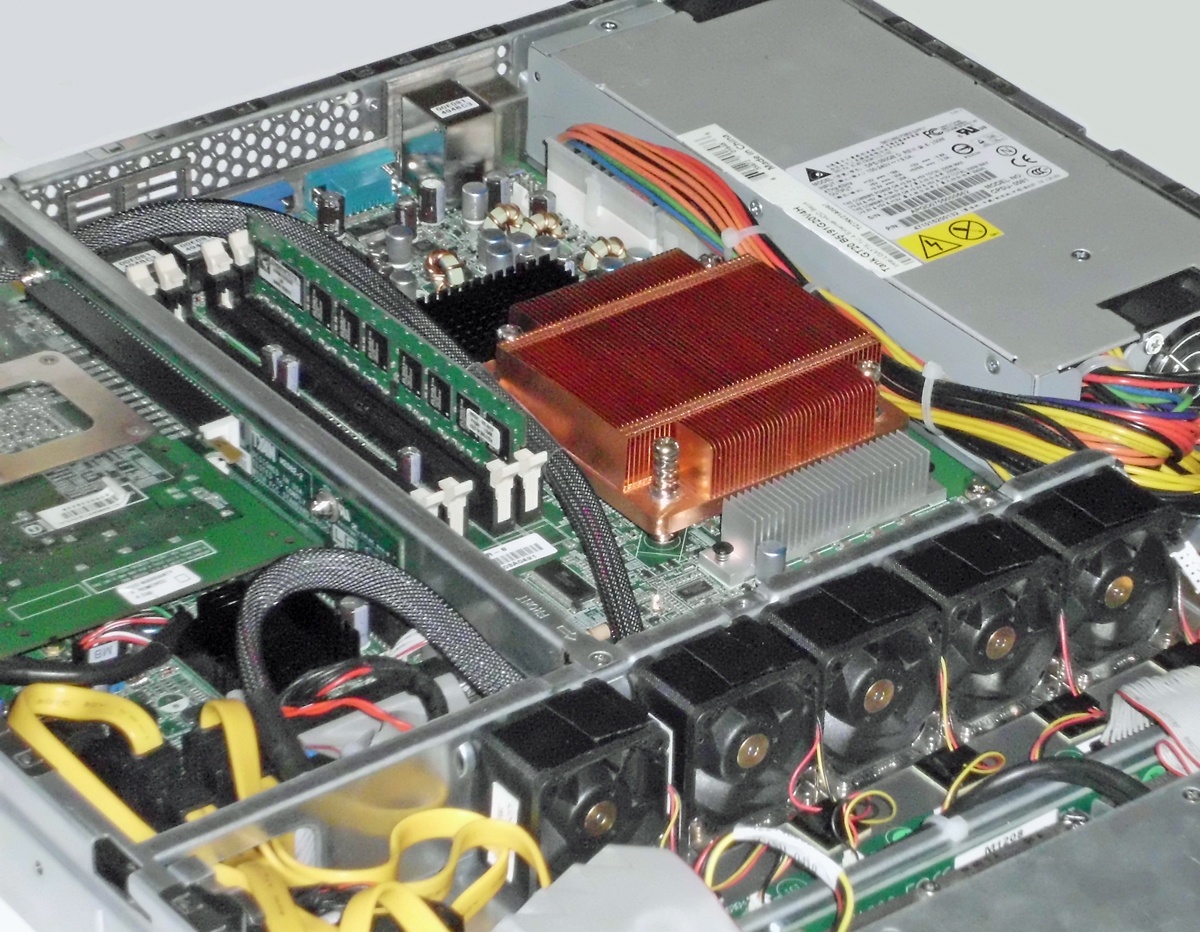
Interior of a 1U rack-mount server. Photo: Tobias Maier via Wikimedia Commons, CC0 1.0 public domain dedication.
Quick Answer: Round Rock-based Dell Technologies booked a record $60.9 billion in AI server orders in its fiscal 2027 second quarter and ended the period with a record $95 billion AI server backlog. Quarterly revenue reached a record $47.0 billion, up 58% from a year earlier, and the company raised its full-year revenue outlook by $25 billion to $192 billion. Its fiscal third-quarter report, expected this week, will show how quickly that backlog is turning into shipments.
A record AI hardware order book belongs to a Texas company that many people still think of as a personal computer maker. Dell Technologies, based in Round Rock, reported on September 1, 2026 that its AI-optimized server business doubled from a year earlier, and that the orders waiting to be built and shipped were worth more than four-fifths of everything the company sold in its previous fiscal year. This article walks through the numbers in Dell’s own earnings release and what analysts are watching next, as of November 22, 2026.
What are the key numbers behind Dell’s AI server business?
| Measure (fiscal Q2 2027, ended July 31, 2026) | Figure |
|---|---|
| AI server orders booked in the quarter | $60.9 billion (record) |
| AI-optimized server revenue | $16.4 billion, up 100% |
| AI server backlog at quarter end | $95 billion (record) |
| AI server orders over the prior 12 months | More than $130 billion |
| Total net revenue | $46.97 billion, up 58% |
| Diluted earnings per share | $6.34 GAAP; $7.04 non-GAAP |
| Full-year fiscal 2027 revenue guidance | $192.0 billion, up 69% |
| Full-year AI-optimized server revenue guidance | $74.0 billion, up 200% |
| Headquarters | Round Rock, Texas |
Every figure in the table comes from Dell’s second-quarter earnings release or from management comments reported alongside it. Dell’s fiscal year runs roughly February through January, so fiscal 2027 covers most of calendar 2026.
How big is Dell’s AI server order book?
Three figures define the quarter. Dell booked $60.9 billion in AI server orders, recognized $16.4 billion in AI-optimized server revenue, and exited the period with a $95 billion backlog. All three were company records, according to Jeff Clarke, Dell’s vice chairman and chief operating officer, who presented them in the release.
For scale, Dell’s total revenue for all of fiscal 2026 was $113.5 billion, according to a Zacks analysis published by Nasdaq. The AI server backlog alone now equals roughly 84% of that full-year total. Clarke also said the company had booked more than $130 billion in AI server orders over the prior 12 months, a figure reported by Futurum Research in its review of the quarter.
How fast did the backlog grow?
The backlog nearly doubled in a single quarter. An Earnings Whispers preview published November 16 put the prior-quarter backlog at $51.3 billion, which means it rose by more than $43 billion in three months even as Dell shipped $16.4 billion of AI servers. Orders in the quarter were about 3.7 times the AI server revenue recognized, which is why the backlog expanded rather than shrank.
Who is buying Dell’s AI servers?
Dell does not break out orders by customer in its release. Futurum Research reported that demand in the quarter included CoreWeave, Nscale Global Holdings, corporate clients and major AI providers, a mix that spans specialized AI cloud operators and enterprise buyers. That breadth matters to the order book’s quality, because a backlog concentrated in a handful of cloud builders carries different risks than one spread across many companies.
What did Dell report for the quarter?
Total net revenue was $46,971 million for the three months ended July 31, 2026, compared with $29,776 million a year earlier. Operating income tripled to $5,385 million and net income reached $4,133 million, up 255%. The Infrastructure Solutions Group, which holds servers, networking and storage, produced about two-thirds of revenue and 81% of reportable segment operating income.
| Segment line | Q2 FY27 revenue | Q2 FY26 revenue | Change |
|---|---|---|---|
| AI-Optimized Servers | $16,401M | $8,208M | +100% |
| Traditional Servers and Networking | $10,531M | $4,736M | +122% |
| Storage | $4,850M | $3,856M | +26% |
| Infrastructure Solutions Group total | $31,782M | $16,800M | +89% |
| Commercial client | $13,192M | $10,781M | +22% |
| Consumer client | $1,842M | $1,722M | +7% |
| Client Solutions Group total | $15,034M | $12,503M | +20% |
| Total net revenue | $46,971M | $29,776M | +58% |
AI-optimized servers accounted for about 35% of Dell’s total revenue in the quarter, up from about 28% a year earlier. Over the first six months of the fiscal year, AI-optimized server revenue was $32,533 million, more than three times the $10,090 million recorded in the same period a year before.
Is the growth only about AI servers?
No. Traditional servers and networking grew faster in percentage terms than AI servers, rising 122% to $10.5 billion. Clarke said that in the past two quarters Dell generated almost as much revenue from traditional servers and networking as in any prior full year in its history. Futurum Research attributed the surge to renewed demand for systems built around central processing units, which handle AI agent management and related workloads that sit beside the graphics-processor-heavy machines.
Storage revenue rose 26% to $4.9 billion, a second-quarter record. Futurum noted that Dell’s Lightning parallel file system, designed for AI training and inference workloads, is in beta testing with several customers. The client business, which sells personal computers, grew 20% to $15.0 billion, led by commercial buyers.
Did AI servers hurt profit margins?
The quarter’s results pointed the other way. Gross margin was 20.9% of revenue, up from 18.3% a year earlier. Operating expenses fell to 9.5% of revenue from 12.3%, and operating income rose to 11.5% of revenue from 6.0%. Inside the infrastructure segment, operating income was $4,781 million, or 15.0% of segment revenue, compared with 8.8% a year earlier.
The Zacks analysis described the outcome as scale outweighing product mix: AI servers have been viewed as lower-margin products, yet the segment’s profit grew faster than its revenue. The Earnings Whispers preview added a caution, reporting that management warned some favorable mix and rate benefits will not repeat every quarter.
What is Dell forecasting for the rest of fiscal 2027?
Dell raised its full-year outlook across every line. David Kennedy, the chief financial officer, said the company lifted its fiscal 2027 revenue outlook by $25 billion to $192 billion. The Earnings Whispers preview described it as the third consecutive increase to the full-year view.
| Guidance item | Previous | Updated | Year-over-year |
|---|---|---|---|
| FY27 revenue | $167.0B | $192.0B | +69% |
| FY27 AI-optimized server revenue | $60.0B | $74.0B | +200% |
| FY27 GAAP diluted EPS | $17.31 | $24.37 | +181% |
| FY27 non-GAAP diluted EPS | $17.90 | $25.50 | +148% |
| Q3 FY27 revenue | n/a | $49.0B | +81% |
| Q3 FY27 non-GAAP diluted EPS | n/a | $6.50 | +151% |
How much AI server revenue has to ship in the second half?
The arithmetic is direct. Dell recognized $32.5 billion of AI-optimized server revenue in the first half and is guiding to $74.0 billion for the year, which leaves about $41.5 billion to be delivered in the third and fourth quarters combined. That is an average of nearly $21 billion per quarter, well above the $16.4 billion recognized in the second quarter. With $95 billion already in backlog, the constraint is the ability to build and deliver, not the availability of orders.
What does the balance sheet show about the build-out?
The balance sheet reflects a company stocking up to build. Inventories more than doubled in six months, to $21,290 million at July 31, 2026 from $10,437 million at January 30, 2026. Accounts payable climbed to $49,723 million from $33,630 million over the same period, and accounts receivable rose to $22,918 million from $17,585 million.
Spending on capacity and engineering also increased. Capital expenditures and capitalized software development costs were $1,239 million in the quarter, compared with $675 million a year earlier. Research and development expense rose 41% to $1,109 million. Cash flow from operations was $2,225 million, down 13% from a year earlier as working capital absorbed cash, while adjusted free cash flow, a non-GAAP measure, was $8,149 million. Cash and cash equivalents stood at $11,569 million, with long-term debt of $25,985 million.
How much cash went back to shareholders?
Dell said it returned a record $4.3 billion to shareholders in the quarter. The cash flow statement shows $3,796 million of common stock repurchases and $405 million of dividends and dividend equivalents. Weighted average diluted shares fell to 652 million from 686 million a year earlier. On September 1 the board declared a quarterly cash dividend of $0.63 per common share.
What could slow the conversion of backlog into revenue?
Supply is the main limit named by analysts. Futurum Research wrote that constraints extend across semiconductors, substrates, optics, cooling and power infrastructure, and that supply availability remains the main constraint on the AI systems business. The Earnings Whispers preview said memory supply has been the limiting factor on recent earnings calls.
Dell’s own risk disclosures in the release point to the same pressure points, listing its relationships with third-party suppliers for products and components, its use of single-source or limited-source suppliers, and the effects on operating performance related to demand for AI solutions. The preview also raised the question of customer financing, noting that any sign of AI cloud customers struggling to fund purchases would revive concerns about the quality of demand.
What will the third-quarter report need to show?
Dell’s fiscal third-quarter results are expected this week. Management guided to revenue of about $49.0 billion, within a range of $48.5 billion to $49.5 billion, and non-GAAP diluted earnings of about $6.50 per share, within a range of $6.40 to $6.60. According to the Earnings Whispers preview, analysts expect $50.63 billion in revenue and $6.63 per share, both above the company’s guidance. A year earlier Dell reported third-quarter revenue of $27.01 billion and earnings of $2.35 per share.
The preview framed the report around three questions: whether AI server shipments rise while new orders stay healthy, whether the infrastructure segment holds a margin near the 15% reached in the second quarter, and whether traditional servers and storage keep growing. It also noted that Dell shares had fallen about 25% since the second-quarter report despite the record results.
Why does Dell’s order book matter for Texas?
Dell is headquartered in Round Rock, and its results are a direct read on how much AI computing equipment customers are committing to buy. A backlog of $95 billion in AI servers represents machines that still have to be assembled, tested, installed in data centers and supplied with power and cooling. The 122% growth in traditional servers and networking shows that AI projects are also pulling in conventional computing equipment, which widens the range of suppliers and service providers tied to the build-out.
The figures also mark a change in what kind of company Dell is. In the second quarter, infrastructure products generated more than twice the revenue of the client business that built the company’s name. Futurum Research noted that Dell expects full-year operating expenses of about 8% of revenue, which it described as the lowest rate in the company’s 42-year history.
Brian’s Take
As a former investment manager and analyst, the number I keep coming back to here is not revenue. It is the gap between $60.9 billion of orders and $16.4 billion of shipments in the same quarter. Demand is not Dell’s problem. Getting parts, building systems and delivering them is.
The balance sheet tells the same story in plainer terms. Inventories doubled in six months and payables rose by $16 billion. That is a company leaning hard on its supply chain to turn a backlog into revenue, and it is why operating cash flow slipped even while profit tripled. To me, those working capital lines are worth as much attention as the headline growth rates.
For Texas business, I read this as evidence that AI spending has moved from announcements to purchase orders. A Round Rock company holding $95 billion of signed AI server business is a concrete marker. Whether suppliers of memory, optics, cooling and power can keep pace is the open question, and the answer will shape how fast that backlog becomes delivered equipment.
Frequently Asked Questions
How large is Dell’s AI server backlog?
Dell reported a record $95 billion AI server backlog at the end of its fiscal 2027 second quarter on July 31, 2026, up from $51.3 billion one quarter earlier.
How much AI server revenue does Dell expect in fiscal 2027?
Dell guided to $74.0 billion in AI-optimized server revenue for fiscal 2027, up 200% from the prior year and raised from a previous forecast of $60.0 billion.
What was Dell’s total revenue in the second quarter of fiscal 2027?
Net revenue was $46.97 billion, a company record and 58% above the same quarter a year earlier. The Infrastructure Solutions Group contributed $31.8 billion and the Client Solutions Group $15.0 billion.
Where is Dell Technologies headquartered?
Dell Technologies is headquartered in Round Rock, Texas. Its common stock trades on the New York Stock Exchange under the symbol DELL.
What is limiting Dell’s AI server shipments?
Analysts cite component supply. Futurum Research pointed to constraints in semiconductors, substrates, optics, cooling and power infrastructure, and Earnings Whispers identified memory supply as the limiting factor on recent calls.
When does Dell report its next results?
Dell’s fiscal 2027 third-quarter report is expected this week. The company guided to about $49.0 billion in revenue and about $6.50 in non-GAAP diluted earnings per share.
Sources and Further Reading
- Dell Technologies Delivers Second Quarter Fiscal 2027 Financial Results, Dell Technologies via Business Wire
- Dell Technologies Q2 FY 2027: AI Orders Fuel Server and Storage Growth, Futurum Research
- Dell’s $95 Billion Backlog Answers the AI Question, Zacks Investment Research via Nasdaq
- Dell Must Prove Its $95 Billion AI Backlog Can Convert Despite Memory Constraints, Earnings Whispers