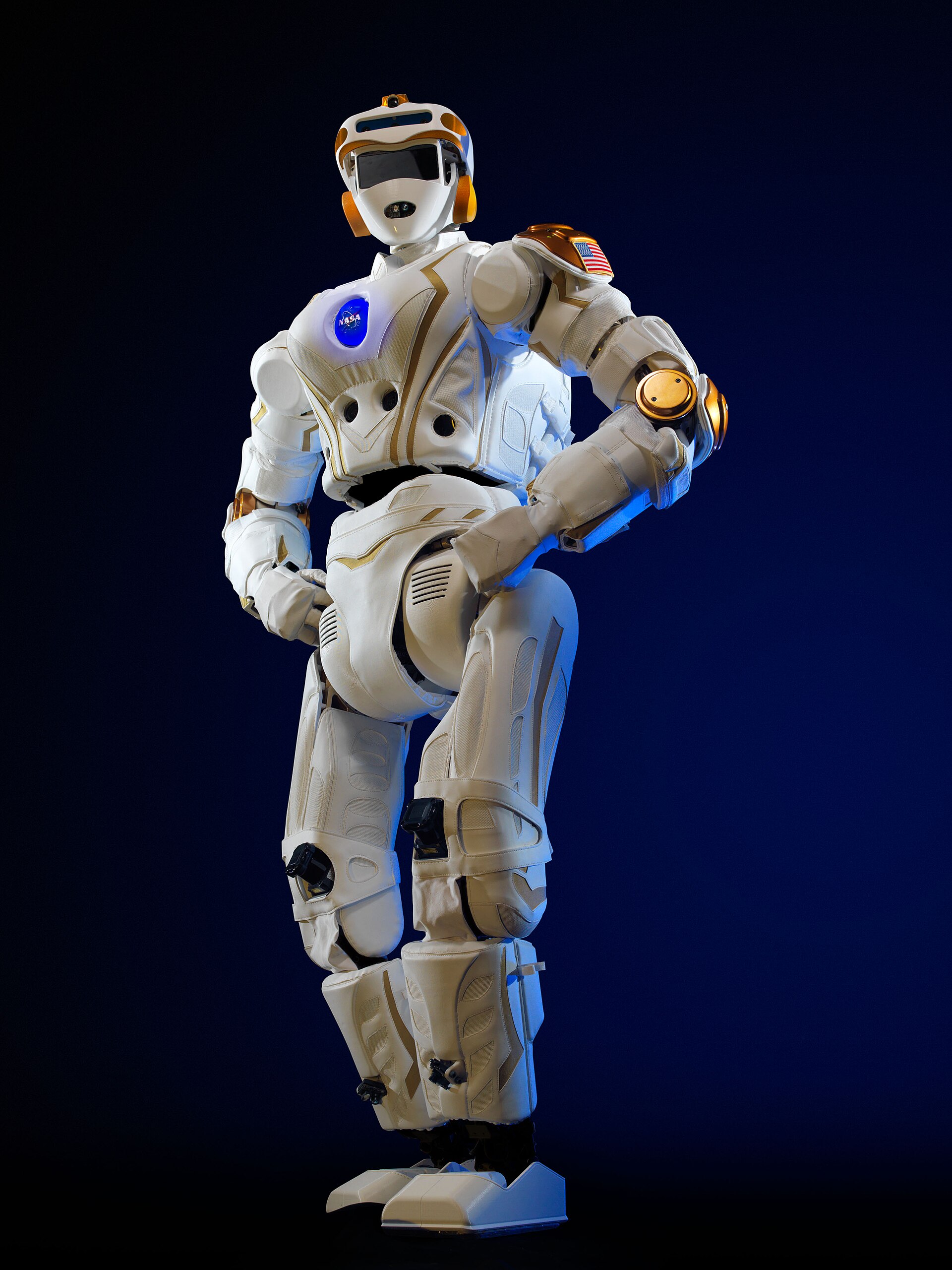
Photo: NASA, via Wikimedia Commons. Public domain.
Quick Answer
Austin has become a center of U.S. humanoid robot development. Apptronik, a University of Texas at Austin spinout, has raised more than $935 million in Series A funding and opened a nearly 90,000-square-foot training facility called Robot Park in June 2026, while Tesla is building a dedicated factory for its Optimus robot at its Giga Texas campus. As of November 20, 2026, neither company has disclosed volume commercial production in Texas.
Humanoid robots are the part of the artificial intelligence industry where software meets a factory floor. The machines depend on AI models trained on large amounts of physical data, and they depend on a manufacturing base that can build actuators, batteries and hands at scale. Austin now hosts both kinds of work. This report covers what Apptronik has raised and built, what Tesla has said about its Texas robot plant, and how the two efforts compare.
What is Apptronik and where did it come from?
Apptronik was established in 2016 out of the Human Centered Robotics Lab at the University of Texas at Austin. Jeff Cardenas is co-founder and chief executive, and Dallas Innovates also names Nicholas Paine as a co-founder. The company is an alumni portfolio company of the Austin Technology Incubator at UT Austin.
Its roots are in government robotics. Members of the UT lab competed in the 2013 NASA-DARPA Robotics Challenge with a humanoid called Valkyrie, TechCrunch reported, and the company says its current robot draws on 15 earlier machines, including NASA’s Valkyrie. Dallas Innovates reports that early work also included exoskeletons for U.S. Special Forces. The company describes its Apollo humanoid as the product of nearly a decade of development.
| Item | Detail |
|---|---|
| Headquarters | Austin, Texas |
| Founded | 2016, from the UT Austin Human Centered Robotics Lab |
| Chief executive | Jeff Cardenas, co-founder |
| Flagship product | Apollo humanoid robot |
| Employees | More than 350 (June 2026) |
| Series A total | More than $935 million |
| Total capital raised | Nearly $1 billion (February 2026) |
| Named commercial partners | Mercedes-Benz, GXO Logistics, Jabil |
| AI partner | Google DeepMind (Gemini Robotics) |
Sources: Apptronik company announcements, February 11 and June 30, 2026; Austin Technology Incubator.
How much money has Apptronik raised?
The funding history is short and steep. Before 2025, Apptronik had raised about $28 million in total, according to TechCrunch, and its chief executive said the company had earned more in revenue from pilots and robot sales during that period than it had raised from investors.
On February 13, 2025, the company announced a $350 million Series A co-led by B Capital and Austin-based Capital Factory, with Google participating. The round was later enlarged, and the company describes the initial Series A as oversubscribed at $415 million. On February 11, 2026, Apptronik announced a $520 million extension it calls Series A-X, bringing the Series A to more than $935 million and total capital raised to nearly $1 billion.
| Date | Event | Amount |
|---|---|---|
| Before 2025 | All earlier funding combined | About $28 million |
| February 13, 2025 | Series A announced, co-led by B Capital and Capital Factory | $350 million |
| 2025 | Initial Series A as later enlarged | $415 million |
| February 11, 2026 | Series A-X extension | $520 million |
| February 11, 2026 | Series A total | More than $935 million |
Sources: Apptronik; TechCrunch; The Robot Report.
The extension accounts for about 56% of the full Series A. The Series A as a whole is roughly 33 times everything the company had raised in its first eight years.
Who invested in the extension?
Existing investors B Capital, Google, Mercedes-Benz and PEAK6 took part. New investors were AT&T Ventures, the Dallas-based venture arm of AT&T, along with John Deere and the Qatar Investment Authority. Two of the backers, Mercedes-Benz and Google, are also working partners, and John Deere and AT&T bring agricultural equipment and connectivity businesses into the investor group.
What is the company valued at?
Apptronik has not published a dollar valuation. It said the extension was opened at three times the valuation of the original Series A. Dallas Innovates cited a reported post-money valuation of roughly $5.3 billion. That figure comes from press reports and has not been confirmed in a company release reviewed for this article.
What will the money be used for?
The company listed four uses: ramping production of Apollo, expanding commercial and pilot deployments, building facilities for robot training and data collection, and developing a new robot. The third item became visible within five months.
What is Robot Park?
On June 30, 2026, Apptronik announced Robot Park, which it calls its flagship data collection and training facility, and unveiled the Apollo 2 robot. The site covers nearly 90,000 square feet in Austin. According to the Association for Advancing Automation, the company first leased about 60,000 square feet across the street from its headquarters around the time of the funding announcement and then expanded. Cardenas said the building formerly housed a Dell server plant.
The change in scale is large. Semafor reported that the company’s previous testing area could hold roughly 10 robots at a time, and that a company spokesperson said hundreds of its latest humanoids will operate at Robot Park. Semafor described the warehouse as about the size of two football fields.
The purpose is data. Simulation can run around the clock, but it does not capture worn hardware or a foot slipping on a floor. At Robot Park, robots practice the jobs that customers want done, such as packaging items, sorting tools and moving boxes on shelving, using a mix of teleoperation and autonomous execution. Apptronik says the data helps advance Google DeepMind’s Gemini Robotics models, and that similar data collection workflows have been deployed at Mercedes-Benz and GXO sites. The company says Robot Park is part of a growing network of such sites at customer and partner locations, with more cities to follow, though it has given no dates.
What is new in Apollo 2?
Apollo 2 is modular and comes in a two-legged version and a wheeled-base version. The company says the wheeled base is designed to meet existing safety standards for industrial mobile robots. Semafor noted that the industry has not yet settled safety standards for two-legged robots working near people, and reported that Apptronik upgraded the wheeled robot because of high demand.
According to the Association for Advancing Automation’s account of a call with Cardenas, the changes from the first Apollo include a new generation of actuators, a larger battery with a runtime of about four hours depending on the task, a safety-rated battery that allows the robot to go to customer sites, new sensor and camera placement, and testing of different hands. The wheeled version can reach up to seven feet. Testing of Apollo 2 began in February 2025.
Cardenas described Apollo 2 as a prototype and a data collection platform, not a production system. Apptronik says a next-generation commercial product, Apollo 3, will follow. No launch date or production volume has been announced.
Who are Apptronik’s customers and partners?
Mercedes-Benz. On March 15, 2024, the two companies announced a commercial agreement to pilot Apollo in Mercedes-Benz manufacturing facilities. It was described as the first publicly announced commercial deployment of Apollo. Mercedes-Benz later became an investor.
Jabil. On February 25, 2025, Apptronik and Jabil, a contract manufacturer based in St. Petersburg, Florida, announced that Jabil would become the manufacturing partner for Apollo. Newly built units are to be tested in Jabil’s own factories on tasks such as inspection, sorting, kitting, lineside delivery, fixture placement and sub-assembly before going to customers. Financial terms were not disclosed.
GXO Logistics. The logistics company is named as a partner and as a site where Apptronik’s data collection workflows have been deployed.
Google DeepMind. The partnership pairs Apptronik hardware with Gemini Robotics models.
The stage of these relationships matters. In February 2025, Cardenas told TechCrunch that no partnership had yet moved beyond the pilot stage and that the company had not reached its target price of below $50,000 per robot. Dallas Innovates reported in February 2026 that the plan called for pilots through 2026 and broader scaling in 2027 and beyond.
What is Tesla building in Austin?
Tesla is the other large humanoid effort in the Austin area. In November 2025, Drive Tesla reported that the company had begun construction on a dedicated Optimus production facility at its Giga Texas complex, with land clearing and foundation work under way. The report said the plant is designed for up to 10 million robots a year once fully ramped, a plan first described at Tesla’s 2025 annual shareholder meeting, and that initial production was expected in 2027.
On Tesla’s third-quarter 2026 earnings call on October 21, 2026, chief financial officer Vaibhav Taneja said the company is building an Optimus factory in Austin that will be able to produce far more robots than its line in Fremont, California, according to Tesla North. The installed capacity table in Tesla’s third-quarter update listed California as in early ramp and Texas as under construction, with no capacity figure for either. No opening date was given.
Chief executive Elon Musk said on the same call that Tesla needs roughly 10,000 to 20,000 robots so they can learn through practice, and that the company is building robots while it continues to work on hands, training and the supply chain. Those are company statements about plans, not production results.
How do the two Austin efforts compare?
| Measure | Apptronik | Tesla Optimus in Texas |
|---|---|---|
| Texas site | Headquarters and Robot Park, Austin | Dedicated plant at Giga Texas |
| Site status | Robot Park opened June 30, 2026 | Listed as under construction, October 2026 |
| Disclosed scale | Nearly 90,000 square feet | Reported design of up to 10 million robots a year |
| Funding | More than $935 million Series A | Not disclosed separately |
| Manufacturing approach | Jabil as manufacturing partner | In-house |
| Current robot | Apollo 2, described as a prototype | Early production builds in Fremont |
| Stated timing | Pilots through 2026, scaling from 2027 | Initial Texas production reported for 2027 |
Sources: Apptronik; Association for Advancing Automation; Drive Tesla; Tesla North.
The strategies differ. Apptronik is venture funded, sells to outside manufacturers and logistics operators, and relies on a contract manufacturer and an outside AI lab. Tesla is building its own plant and its own production line.
How does Austin fit into the national humanoid market?
Capital has moved into the category quickly. The Robot Report listed 2025 raises of $1 billion for Figure AI and $400 million for Agility Robotics. Apptronik’s $935 million Series A puts an Austin company in that group.
Texas is also a deployment market. Agility Robotics deployed its Digit robot with Mercado Libre in San Antonio in 2025, The Robot Report noted. For Texas manufacturers and warehouse operators, the practical questions are price, safety certification and uptime. The published figures give partial answers: a target price below $50,000 that had not been reached as of early 2025, a battery runtime of about four hours, and a wheeled design built around existing industrial safety standards.
Frequently Asked Questions
Where is Apptronik based?
Austin, Texas. The company was established in 2016 out of the Human Centered Robotics Lab at the University of Texas at Austin.
How much has Apptronik raised?
More than $935 million in its Series A, including a $520 million extension announced February 11, 2026. The company says total capital raised is nearly $1 billion.
What is Robot Park?
A nearly 90,000-square-foot facility in Austin, announced June 30, 2026, where Apollo robots perform customer-style tasks to generate training data.
Is Apollo in commercial production?
Apollo 2 has been described by the chief executive as a prototype and data collection platform. A commercial product, Apollo 3, has been announced without a launch date.
Is Tesla making Optimus robots in Texas?
Not yet in volume, based on company statements. Tesla’s third-quarter 2026 update listed its Texas Optimus plant as under construction.
Sources and Further Reading
- Apptronik Closes Over $935 Million Series A with New $520 Million Extension Round, Apptronik (February 11, 2026)
- Welcome to Robot Park: Where Apptronik’s Apollo Goes to Work, Apptronik (June 30, 2026)
- Apptronik brings in another $520M to ramp up Apollo production, The Robot Report
- Apptronik raises $350M to build humanoid robots with help from Google, TechCrunch (February 13, 2025)
- Apptronik opens 90,000 sq ft testing site for new Apollo 2 humanoid, Association for Advancing Automation
- Apptronik turns robot simulations into reality, Semafor (July 2, 2026)
- AT&T Ventures Among New Backers as Humanoid Robotics Startup Apptronik Nears $1B in Total Funding, Dallas Innovates
- Apptronik collaborates with Jabil to produce Apollo humanoid robots, The Robot Report (February 25, 2025)
- Apptronik and Mercedes-Benz Enter Commercial Agreement, Austin Technology Incubator, University of Texas at Austin (March 15, 2024)
- Tesla Is Building a Bigger Optimus Factory in Austin, CFO Says, Tesla North (October 22, 2026)
- Tesla Breaks Ground on Optimus Factory Beside Giga Texas, Drive Tesla (November 11, 2025)