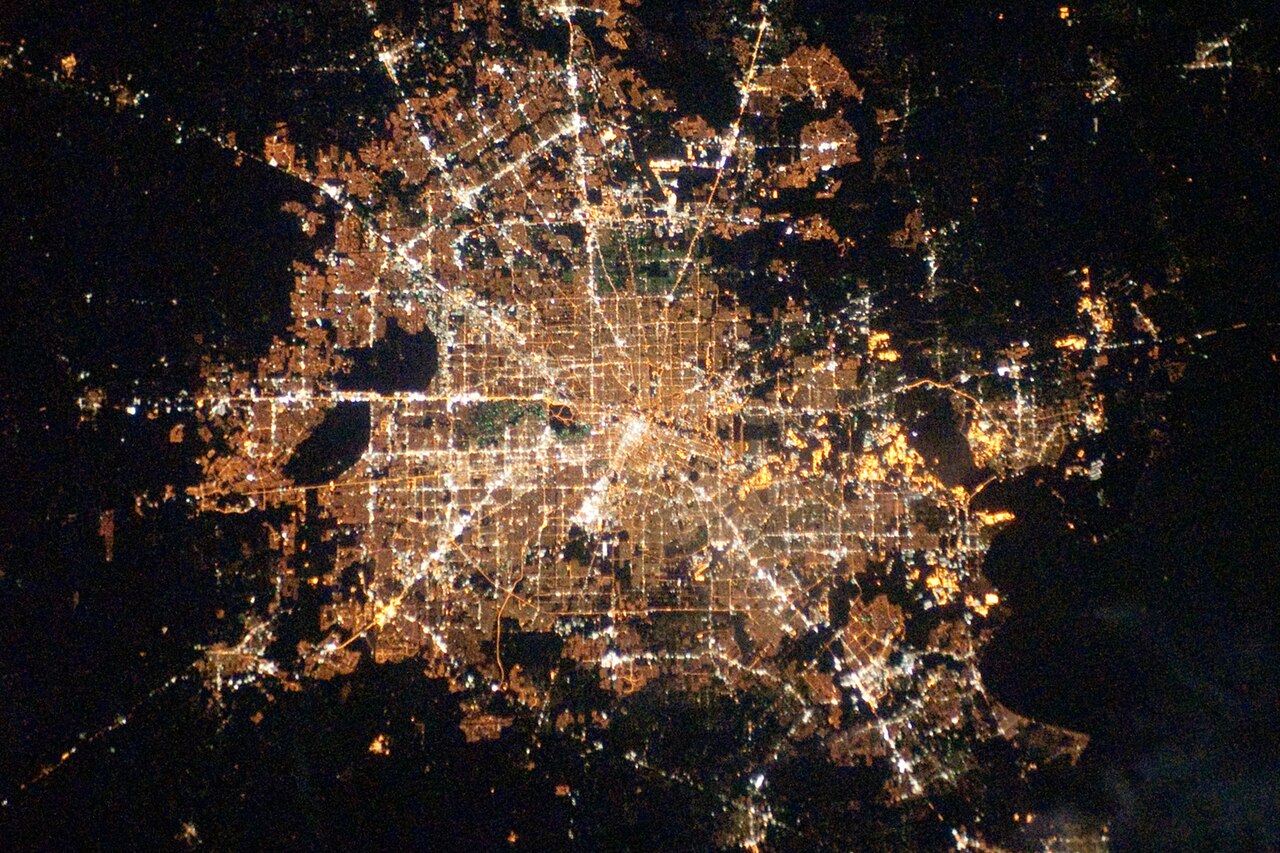
Photo: NASA, ISS Expedition 22 crew (ISS022-E-78463) / Wikimedia Commons. License: Public domain (U.S. government work).
Texas now has a public count of its driverless industry. Since late May 2026, any company that carries passengers or freight for hire without a human driver must hold an authorization from the Texas Department of Motor Vehicles, and the agency publishes how many vehicles each holder has listed. This report uses that registry, state program documents and company announcements to show who is operating as of November 18, 2026 and what the state requires.
How many driverless operators are authorized in Texas?
The department’s Company and Vehicle Summary Report, with data as of November 16, 2026, lists 17 authorized companies and 3,451 automated vehicles. The same report dated October 29, 2026 showed 17 companies and 3,164 vehicles, so the total grew by 287 vehicles in under three weeks.
| Authorized company | Vehicles, Oct. 29, 2026 | Vehicles, Nov. 16, 2026 |
|---|---|---|
| Waymo | 1,259 | 1,321 |
| Tesla Robotaxi | 1,080 | 1,306 |
| Avride | 344 | 344 |
| Aurora | 91 | 91 |
| Gatik AI | 64 | 64 |
| Zoox | 63 | 63 |
| Fountainhead Logistics (Atlas Energy Solutions) | 38 | 52 |
| Nuro | 47 | 47 |
| Torc Robotics | 32 | 32 |
| Stack Opco | 31 | 31 |
| Kodiak Robotics | 36 | 26 |
| May Mobility | 22 | 22 |
| Bot Auto TX | 13 | 17 |
| MOIA America | 12 | 12 |
| PlusAI | 12 | 12 |
| International Transport Engineering | 7 | 7 |
| Waabi Logistics | 13 | 4 |
| Total | 3,164 | 3,451 |
What do the registry numbers actually measure?
They count vehicles listed on each company’s authorization. They do not show how many vehicles are carrying riders or freight on a given day, where they operate, or whether a human is on board for a particular trip. When the registry first became public on May 28, 2026, TechCrunch noted that fleet size does not indicate commercial status and that Nuro and Zoox were not operating commercially in Texas at that time.
TechCrunch reported 577 Waymo vehicles and 42 Tesla vehicles on the list at launch. By November 16 the department’s report showed 1,321 and 1,306, respectively. Waymo and Tesla together hold 2,627 of the 3,451 listed vehicles, about 76% of the state total.
Which driverless ride-hail services are running in Texas cities?
Who operates in Austin?
Austin is the most crowded market. Waymo began offering rides there through the Uber app in March 2025, at first on surface streets only. On September 24, 2026, Waymo said riders could book freeway trips through Uber on MoPac Expressway, Interstate 35, U.S. 183 and U.S. 290, with access rolling out gradually. Waymo told Axios in spring 2026 that its Austin fleet stood at 300 vehicles and had driven 10.7 million fully autonomous miles in the city, according to a May 3, 2026 Dallas Express report.
Tesla launched its Robotaxi service in Austin in summer 2025. On the company’s third-quarter 2026 call, executives said rides in the two-seat Cybercab began in Austin on September 3, 2026 and that every Cybercab built on the Texas production line so far had gone into Tesla’s own Robotaxi fleet, according to an October 21, 2026 Tesla North summary of the call.
Zoox said in March 2026 that it would begin deploying its purpose-built vehicles in Austin, starting with employee riders, then friends and family, and eventually the public, Transport Topics reported. The state registry lists 63 Zoox vehicles.
Who operates in Dallas?
Dallas has three ride-hail entrants. Uber and Austin-based Avride launched robotaxi service on December 3, 2025 in about 9 square miles covering downtown, Uptown, Turtle Creek and Deep Ellum, using Hyundai Ioniq 5 vehicles with an on-board specialist behind the wheel at launch, Dallas Innovates reported. Avride has 344 vehicles on its Texas authorization.
Waymo opened service to select riders in Dallas on February 24, 2026, the same day it did so in Houston, San Antonio and Orlando, bringing its count to 10 U.S. metro areas at that point.
Tesla said on April 18, 2026 that its service was rolling out in Dallas and Houston. Tesla’s Robotaxi Safety Report showed 608,130 miles in Dallas with no safety monitor on board as of October 18, 2026, second only to Austin, and executives said the Cybercab would launch in Dallas in November 2026, Tesla North reported.
Who operates in Houston and San Antonio?
Waymo’s Houston service started with about 25 square miles inside a portion of the Interstate 610 loop, including downtown, Midtown, Montrose and the Heights, KERA News reported. Tesla’s Houston service began in April 2026. San Antonio has Waymo service that began with invited riders in February 2026.
| City | Operator | Start of public rides | Reported detail |
|---|---|---|---|
| Austin | Waymo (via Uber) | March 2025 | 300 vehicles (spring 2026); freeway trips since Sept. 24, 2026 |
| Austin | Tesla Robotaxi | Summer 2025 | Cybercab rides since Sept. 3, 2026 |
| Dallas | Avride (via Uber) | Dec. 3, 2025 | About 9 square miles at launch |
| Dallas | Waymo | Feb. 24, 2026 | Invited riders first |
| Dallas | Tesla Robotaxi | April 18, 2026 | 608,130 miles without a safety monitor as of Oct. 18, 2026 |
| Houston | Waymo | Feb. 24, 2026 | About 25 square miles at launch |
| Houston | Tesla Robotaxi | April 18, 2026 | Fleet size not disclosed by the company |
| San Antonio | Waymo | Feb. 24, 2026 | Invited riders first |
Who is running driverless trucks on Texas freight corridors?
What routes does Aurora run?
Aurora Innovation began driverless truck operations in April 2025 between Dallas and Houston. In a February 11, 2026 release, the company said its driverless network covered Dallas to Houston, Fort Worth to El Paso, El Paso to Phoenix, Fort Worth to Phoenix and Dallas to Laredo. It described the Fort Worth to Phoenix lane as roughly 1,000 miles and named Hirschbach as an early customer on that route.
The same release reported 250,000 driverless miles as of January 2026 and said the system could now drive without a human in rain, fog and heavy wind.
In February, Aurora said it expected more than 200 driverless trucks in operation by the end of 2026. After its third-quarter report, FreightWaves reported on October 30, 2026 that upfitting partner Roush was expected to deliver 200 trucks by the end of February 2027 following a six-week delay, and that Aurora had 10 driverless customers. Aurora’s Texas authorization lists 91 vehicles.
Which other truck operators are authorized?
- Kodiak: The company said in September 2026 that it was on track to launch driverless highway service on the 219-mile Interstate 45 lane between Dallas and Houston by the end of 2026, working from a hub in Lancaster, Automotive World reported. In the Permian Basin, its system was running in 35 trucks for Atlas Energy Solutions by June 30, 2026, with more than 40,000 paid driverless hours. The registry lists 26 vehicles under Kodiak and 52 under Fountainhead Logistics, which does business as Atlas Energy Solutions.
- Gatik: The company, which runs shorter middle-mile routes, said in January 2026 that it had 10 revenue-generating driverless trucks, including in Dallas-Fort Worth, with plans to reach 60, and had completed 60,000 driverless orders since mid-2025, FreightWaves reported. It has 64 vehicles on its Texas authorization.
- Bot Auto: The Houston-based company announced in February 2026 an overnight lane of roughly 200 miles between Houston and the southern Dallas-Fort Worth area with Ryan Transportation. It has 17 vehicles listed.
- Others: Torc Robotics (32 vehicles), Stack Opco (31), PlusAI (12), International Transport Engineering (7) and Waabi Logistics (4) also hold authorizations.
What does Texas law require of driverless operators?
Senate Bill 2807, passed by the 89th Legislature in 2025 and effective September 1, 2025, rewrote the state’s automated vehicle statute in Transportation Code Chapter 545, Subchapter J. Its core rule: a company may not transport property or passengers commercially without a human driver unless it holds an authorization from the Department of Motor Vehicles. Vehicles owned by individuals and used personally do not need one.
What must an applicant certify?
According to the department, applicants file through the Texas Motor Carrier Credentialing System and acknowledge that each vehicle:
- can operate in compliance with Texas traffic and motor vehicle laws;
- has a recording device;
- uses an automated driving system that complies with federal law;
- can reach a minimal risk condition if the system fails;
- is titled and registered under Texas law; and
- carries liability coverage or self-insurance at the required amount.
The applicant must also certify that the Department of Public Safety has received its plan for how police, fire and emergency medical crews should interact with the vehicle. There is no application fee. Authorizations do not expire, but holders must report material changes within 30 days, and the department’s rules treat adding a vehicle to the fleet as a material change. The rules cover vehicles capable of Level 4 or Level 5 automation.
What are the key dates?
| Date | Event |
|---|---|
| Sept. 1, 2025 | Senate Bill 2807 took effect |
| Feb. 27, 2026 | Department rules in 43 Texas Administrative Code Chapter 220 took effect |
| March 5, 2026 | Rule creating the Automated Vehicle Regulation Advisory Committee took effect |
| May 28, 2026 | Authorization requirement became enforceable |
| June 2, 2026 | Department announced enforcement and a public complaint process |
Who enforces the rules?
Responsibility is split. The Department of Motor Vehicles issues authorizations and can suspend, revoke, cancel or restrict one if it finds a vehicle is not in safe operating condition and its operation endangers the public. The statute sets a process: notice with a period to correct the problem, a decision the holder can ask to have reviewed within 10 days, and an expedited hearing at the State Office of Administrative Hearings that must be held within 60 days. The Department of Public Safety and local police enforce traffic laws on the road. Under the bill, the automated driving system is treated as the vehicle’s operator when engaged, and citations go to the owner or the authorization holder. Operating commercially without authorization is a Class B misdemeanor, with each day counted as a separate offense, according to the Senate Research Center’s bill analysis.
At an August 25, 2026 hearing of the Senate Transportation Committee, department officials said they had received 42 complaints in about three months and had not issued any notice of intent to suspend, revoke or restrict an authorization, Community Impact reported.
Frequently Asked Questions
Is it legal to run a vehicle with no driver in Texas?
Yes. State law allows automated vehicles to operate without a human driver, and since May 28, 2026 commercial operators must hold a Texas Department of Motor Vehicles authorization.
How many driverless vehicles are registered in Texas?
The department’s report showed 3,451 vehicles on 17 companies’ authorizations as of November 16, 2026. That counts listed vehicles, not vehicles in daily driverless service.
Where do driverless trucks run in Texas?
Aurora has said its driverless network covers Dallas to Houston, Fort Worth to El Paso and on to Phoenix, and Dallas to Laredo. Kodiak’s system runs in the Permian Basin for Atlas Energy Solutions, and Gatik operates in Dallas-Fort Worth.
Does Texas charge a fee or require renewal?
No. The department says there is no application fee and authorizations remain valid until suspended, revoked or canceled.
Sources and Further Reading
- Company and Vehicle Summary Reports, Automated Motor Vehicle Authorization Program, data as of October 29 and November 16, 2026, Texas Department of Motor Vehicles
- Automated Vehicles Regulatory Program page, Texas Department of Motor Vehicles
- Texas Begins Enforcement of Commercial Automated Vehicle Requirements, Texas Department of Motor Vehicles
- Adopted rules, 43 Texas Administrative Code Chapter 220, Automated Motor Vehicles, Texas Department of Motor Vehicles
- Adopted rules, 43 Texas Administrative Code Chapter 206, Texas Register, February 27, 2026
- Bill Analysis, S.B. 2807 (Enrolled), Senate Research Center
- Aurora Triples Driverless Network to 10 Routes and Prepares to Expand Across U.S. Sun Belt, Aurora Innovation
- Aurora reaffirms it’s on track to produce more than 1000 trucks in 2027, FreightWaves
- Gatik launches fully driverless commercial trucking operations, FreightWaves
- Kodiak AI targets Dallas-Houston for driverless launch, Automotive World
- Waymo dominates Texas autonomous vehicle registrations as Tesla trails behind, TechCrunch
- Waymo expands fully autonomous freeway rides in Austin, Spectrum News
- Waymo is officially giving rides to Houstonians in fully self-driving cars, KERA News
- Uber Launches Robotaxi Service in Dallas, Dallas Innovates
- Tesla Robotaxi Fleet Gains Ground in Dallas as Texas Driverless Race Grows, Dallas Express
- Bot Auto, Ryan Transportation to launch driverless truck route between Houston and Dallas in 2026, FOX 4 News
- Tesla Q3 Earnings Call takeaways, Tesla North
- Zoox Plans to Expand Robotaxi Service, Transport Topics
- Texas senators weigh impact of driverless vehicles amid recent state regulations, Community Impact